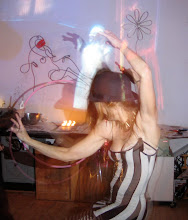
Hooping can be energizing or meditative. It can be done in a massaging, transfixing state or highly aerobic style. Effective with only 20 minutes of practice I think its one of the easiest, most fun and efficient exercise practices available in a small space with inexpensive equipment.
Done to music I often refer to it as hoop dancing though the only dance aspect might be the sinuous movement one naturally develops to keep the hoop swinging. Real hoop dancing is something compelling to watch.
Hoop workout/dancing involves using the hoop in every conceivable way, and even beginners can do moves that are astonishingly beautiful and surprising. There are lots of ways to use the hoop as a workout tool as well as a great alignment aid for stretching. I think everyone benefits from a class where you are shown how not to hurt yourself through overly repeated motions and tense body positions that beginners are prone to while concentrating or when having so much fun they just can’t stop. The first time I hooped i didn’t stop for 2 hours and I warn against that compulsion. Also those tricks that everyone wants to do can be taught in a couple classes though it took us months to figure them out.
In Hoop Groop I like to emphasize the value of the new neurological pathways created when learning something entirely novel to the physical system. New pathways are key in brain plasticity and that has huge payback. I also stress postitive selftalk as we work with the hoop - a chance to break old habits of negative reinforcement; another way to revitalize the body.
Hoops come in a plethora of sizes and weights. The bigger weightier ones are easiest for beginning. Smaller lighter ones are more difficult when it comes to learning some moves. The smaller and lighter the hoop, the faster your reaction time must be inside the hoop. There’s a lot of opinions out there as to what’s best. i know I have mine and they run counter to some opinions out there pandered as facts. I say to each his own and I have a quiver of 25 hoops I bring to class for people to try out and come to their own conclusions.
A LITTLE BACKGROUND
Most people think the gap between the fifties hula hoop and today’s hoopdancing is wide and rather empty, but hoop play and practice has been here all along. There is the Native American hoop dancing which predates the wham-0 hoops and now has a modern style that developed in the 30’s. There’s evidence of grapevine hoop play in ancient Egypt, hooping for weight loss in ancient Greece and a movement in 15th century England.
The hoop dancing we are doing now has been expanding from multiple influences such as flow toy culture (poi, flowsticks), martial arts, rhythmic gymnastics, and popularized in beach culture, Burning Man and live band performance. It became simultaneously obvious that as a byproduct of pure fun - this was a great workout and a whole body workout too. Dancers have made it a beautiful sensual art. What more can you expect from a rock ring which is what they call them in Sweden. I like that.
I believe in the sacred geometry of the hoop - that we instictively recognise and physically experience in our deepest physical systems the orbit of electrons the spin of the earth. As you defy gravity with the rapid circular motion of the hoop you are strengthening the neurological pathways for countering (physical and mental) gravity, maintaining balance and control. These pathways are physiological and psychological. The effects are palpable. To watch a hooper do “isolations”- an illusion technique that is a foundation move for advanced hooping is quite eerie. The hoop seems to hang in the air magically moving and changing direction defying the laws of the world as we usually see it.